
Plug a US-bought blender into a UAE wall socket, and you can kill it in seconds. Bring a Dubai kettle to New York, and it barely gets warm. Same appliance problem, opposite directions, and one fix: the right step-down transformer.
The UAE runs on 230V at 50Hz. The United States runs on 120V at 60Hz, and Japan on just 100V. That gap is why expats, returning students and online shoppers in the Gulf need a voltage transformer before plugging in American or Japanese gear. This guide explains how transformers work, why the world is split between 110V and 220V countries, and how to size one so you don’t overpay or buy too little.

What Is a Step-Down Transformer and How Does It Work?
A step-down transformer lowers mains voltage, typically from the UAE’s 230V to the 110–120V that American appliances expect. Inside are two copper coils wound around an iron core. The input coil has roughly twice as many turns as the output coil, so the output voltage drops to roughly half. No electronics, no tricks: just magnetic induction.
That simplicity is why a proper transformer is the safest way to run a single-voltage appliance abroad. It delivers a clean, continuous AC waveform, so it suits motors, electronics and appliances that run for hours. Cheap “travel converters” are different. They chop the waveform electronically and are only meant for short bursts with simple heating devices, such as a hair dryer.
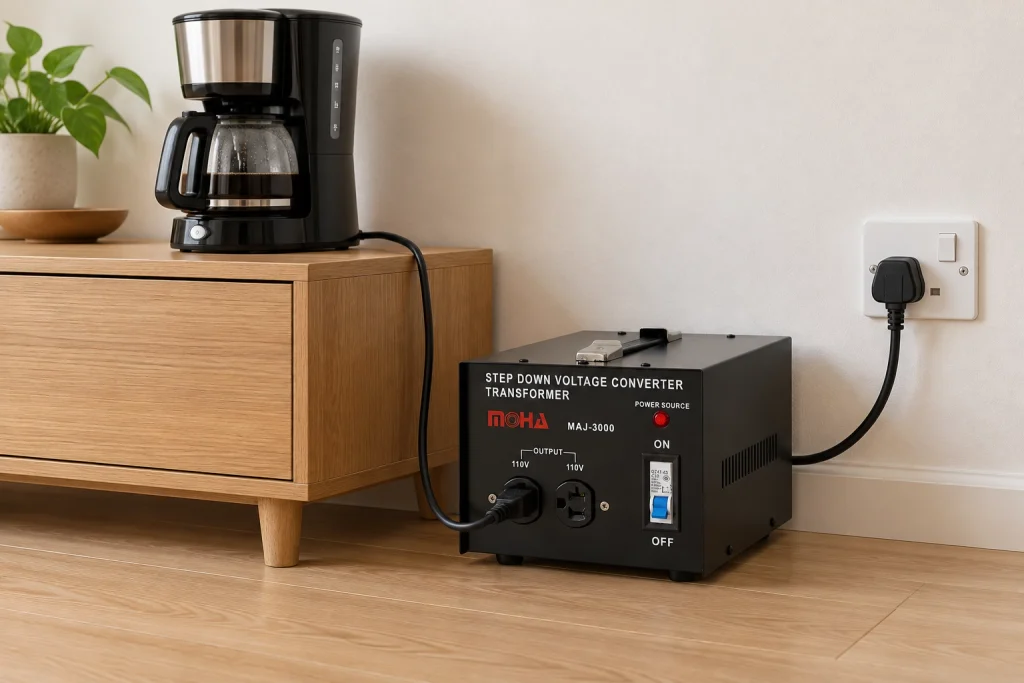
Most units sold in the UAE, including BAM’s range, are built for one job: UK three-pin plug in, US-style sockets out. Many are also reversible step-up/step-down units that can run a 220V appliance on a 110V supply.

Browse the full step-down transformer range to see the formats available, from compact 500W units to 10KVA heavy-duty models.
Transformer vs plug adapter vs travel converter
| Product | What it changes | Best for | Not for |
| Plug adapter | Plug shape only | Dual-voltage chargers, laptops, phones | Any single-voltage 110V or 120V appliance |
| Travel converter (electronic) | Voltage, roughly, for short use | Hair dryers and curling irons on a trip | Electronics, motors, anything left running |
| Step-down transformer | Voltage, cleanly and continuously | Kitchen appliances, TVs, audio, tools, office equipment | Changing frequency (50Hz vs 60Hz) |
Why Do Some Countries Use 110V and Others 220V?
The split comes down to history, not science. In the 1880s, Thomas Edison built America’s first power networks at around 110V DC, because that suited the carbon-filament bulbs of the day. Europe started in a similar place. Then, in 1899, a Berlin utility (BEW) moved to 220V to carry more power over the same copper wires, helped by newer metal-filament lamps that could handle higher voltage.
That Berlin decision spread across Germany and then most of Europe. Higher voltage means lower current for the same power, so cables can be thinner and losses smaller. North America had already wired millions of homes and lamps for 110V, so it stayed put. Today US outlets are nominally 120V at 60Hz, while most of the world, including the whole GCC, sits at 220–240V.
Why don’t Americans just switch? Rewiring a country and replacing every appliance is a huge cost. Instead, US homes get 240V through a split-phase supply for big loads like dryers and ovens, while ordinary sockets stay at 120V.
Japan: 100V and two frequencies
Japan is the odd one out. It runs at 100V, lower even than the US. It also has two frequencies: eastern Japan, including Tokyo, runs at 50Hz, and the west, including Osaka and Kyoto, at 60Hz. That traces back to 1895–96, when Tokyo bought German AEG generators (50Hz), and Osaka bought American General Electric generators (60Hz).
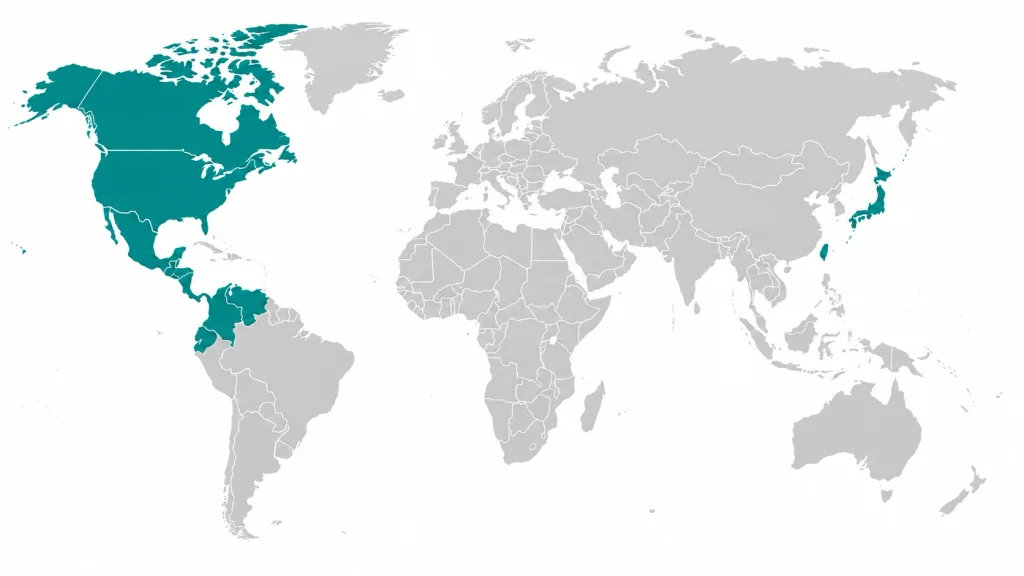
Mains power in common countries
| Country | Voltage | Frequency | Plug type |
|---|---|---|---|
| UAE | 230V | 50Hz | G (UK three-pin) |
| Saudi Arabia | 220V | 60Hz | G |
| United Kingdom | 230V | 50Hz | G |
| Australia | 230V | 50Hz | I |
| United States | 120V | 60Hz | A / B |
| Canada | 120V | 60Hz | A / B |
| Japan | 100V | 50Hz east / 60Hz west | A / B |
| Taiwan | 110V | 60Hz | A / B |
Sources: World Standards, Panasonic, Japan Experience.
Why Do 220V Appliances Feel Weak in the US or Japan?
A 230V appliance on a 120V supply delivers only about 27% of its rated power. On Japan’s 100V, it’s closer to 19%. Your kettle doesn’t break; it just crawls. Hair dryers blow lukewarm air, irons never get properly hot, and motors struggle or stall.
The reason is simple physics. For a heating element, power equals voltage squared divided by resistance (P = V² ÷ R). The element’s resistance doesn’t change, so halving the voltage cuts the power to roughly a quarter, not a half.
| Appliance rated for | Plugged into | Power delivered |
|---|---|---|
| 230V (UAE, UK, Australia) | 230V | 100% |
| 230V | 120V (US) | about 27% |
| 230V | 100V (Japan) | about 19% |
Motors suffer differently. An under-voltage motor draws extra current trying to reach speed, so it can overheat even though it feels weak. If you’re relocating from Dubai to the US or Japan, a step-up transformer (110V to 220V) solves this. Most of the Newstar step-up and step-down transformers work in both directions.

Why Do American and Japanese Appliances Blow Up on 230V?
A 120V appliance plugged straight into a UAE socket receives nearly double its rated voltage. By the same P = V² ÷ R rule, that pushes about 3.7 times its rated power through it. A Japanese 100V appliance gets about 5.3 times. Nothing is designed to survive that.
What happens next depends on the device. Heating elements glow red and burn out. Motors spin too fast and overheat. Power supplies pop capacitors, which is the bang and burning smell people describe. In the worst cases, plastic housings melt and catch fire.
| Appliance rated for | Plugged into UAE 230V | Power forced through |
|---|---|---|
| 120V (US, Canada) | Direct, no transformer | about 3.7× rated |
| 100V (Japan) | Direct, no transformer | about 5.3× rated |
| 100–240V (dual voltage) | Direct, plug adapter only | 100%, safe |
| 100%, safe |
A plug adapter does not protect you here. It only changes the pin shape, so a US plug fits a UK socket while the full 230V still flows through. That’s exactly how many brand-new US appliances die within seconds of unboxing in the Gulf.
Do You Actually Need a Step-Down Transformer?
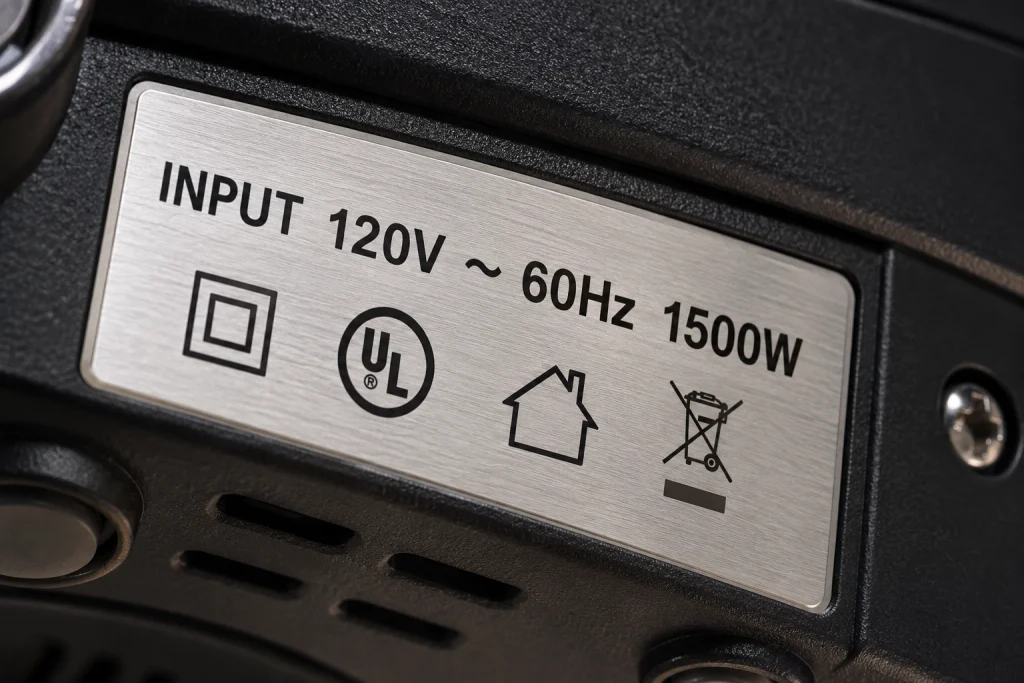
Check the rating label before you buy anything. It’s on the charger brick, the base of the appliance, or the back panel near the power cord. Look for the line marked “INPUT” or “V~”. That one line tells you whether you need a transformer, a plug adapter, or nothing at all.
| Label reads | What it means | What you need in the UAE |
|---|---|---|
| 100–240V ~ 50/60Hz | Dual voltage, works worldwide | A plug adapter only |
| 110–120V ~ 60Hz | US single voltage | A step-down transformer |
| 100V ~ 50/60Hz | Japanese single voltage | A step-down transformer (100V output ideal) |
| 220–240V ~ 50Hz | Built for the UAE, UK, Europe | Nothing, plug straight in |
| 115V/230V switch | Selectable voltage | Set the switch to 230V, then a plug adapter |
Phones, laptops, cameras and most modern chargers are already dual voltage. Kitchen appliances, hair tools, older audio gear, US-market power tools and many gaming accessories are not. Can’t find a label? Check the user manual or the manufacturer’s spec page before plugging in.
While you’re reading the label, note the wattage (W). If it lists amps (A) instead, multiply amps by the voltage: a 120V appliance drawing 10A uses about 1,200W. You’ll need that number in the next step.
How Do You Choose the Right Transformer Wattage?
Take your appliance’s wattage, multiply it by the factor for its load type, then round up to the next transformer size. That’s the whole method. Heaters and electronics need about 1.5× headroom; anything with a motor or compressor needs about 3×, because motors draw several times their running power for the first second after switch-on.
- Find the wattage on the rating label (or amps × volts).
- Pick the multiplier for the load type from the table below.
- Running several devices from one transformer? Add their wattages together and use the highest multiplier among them.
- Round up to the next standard transformer size.
| Load type | Examples | Multiply rated watts by |
|---|---|---|
| Electronics and lighting | TV, audio, gaming console, desktop PC, LED lamps | 1.5× |
| Heating (resistive) | Kettle, toaster, rice cooker, iron, slow cooker, coffee machine | 1.5× |
| Motors and compressors | Blender, stand mixer, vacuum, fridge, power tools, pumps | 3× |
Worked examples
| Appliance (typical rating) | Calculation | Choose |
|---|---|---|
| US TV or console, 200W | 200 × 1.5 = 300W | Newstar 500W |
| US rice cooker, 600W | 600 × 1.5 = 900W | MOHA 1000W or Newstar 1000W |
| US stand mixer, 450W | 450 × 3 = 1,350W | MOHA 1500W or Newstar 1500W |
| US blender, 600W | 600 × 3 = 1,800W | MOHA 2000W or Newstar 2000W |
| US espresso machine, 1,500W | 1,500 × 1.5 = 2,250W | MOHA 3000W or Newstar 3000W |
| US refrigerator or table saw, 1,500W | 1,500 × 3 = 4,500W | MOHA 5000W or Newstar 5000W |
| Workshop or office running several US machines, up to about 5,000W of heating loads | 5,000 × 1.5 = 7,500W | Newstar 10KVA (8,000W) |

What Should You Know Before Plugging In?
A transformer changes voltage, not frequency. The UAE grid runs at 50Hz; US appliances are built for 60Hz. Most heating appliances and modern electronics don’t care. But some motor-driven devices run about 17% slower on 50Hz, and older clocks or timers that count mains cycles will lose time.
Check the label again: “50/60Hz” means you’re fine. “60Hz” only usually still works, but test it under supervision first, especially turntables, older fans and anything with a mains-timed clock.
Safe-use checklist
- Plug the transformer into the wall, never into an extension cord or multi-plug.
- Switch the transformer on first, then the appliance; switch off in reverse order.
- Keep it on the floor or a sturdy surface with space around it for cooling.
- Switch it off at the wall when not in use; transformers draw a little power even when idle.
- Choose a unit with a circuit breaker or fuse protection, and CE marking.
- Feeling warm is normal. Too hot to touch, has a burning smell, or makes a loud buzzing sound, switch it off and resize.
Find the right transformer at BAM
BAM supplies MOHA and Newstar step-down transformers from 500W to 10KVA. Units include UK three-pin input, US output sockets and circuit-breaker or fuse protection. We supply homes, offices, workshops and trade buyers across the UAE and the wider GCC.
Not sure which size fits your appliance? Send us a photo of its rating label on WhatsApp +971 52 374 3008 or through our contact page, and we’ll recommend the right transformer before you buy.
Frequently Asked Questions
Can I use a 110V appliance in the UAE without a transformer?
Only if its label says 100–240V. UAE sockets supply 230V, so a single-voltage 110V or 120V appliance receives nearly double its rated voltage and about 3.7 times its rated power. It will usually fail within seconds. A plug adapter alone does not lower the voltage.
What size step-down transformer do I need?
Multiply the appliance wattage by 1.5 for electronics and heating appliances, or by 3 for anything with a motor or compressor. Then round up to the next standard size. A 600W US blender needs about 1,800W, so a 2000W transformer is the right fit.
Is a voltage converter the same as a transformer?
No. Lightweight electronic “travel converters” are meant for short use with simple heating devices like hair dryers. A step-down transformer uses copper coils to deliver steady, clean power for hours, which suits electronics, motors and kitchen appliances. For anything used daily, choose a transformer.
Does a step-down transformer change 60Hz to 50Hz?
No. A transformer changes voltage only. The UAE runs at 50Hz and the US at 60Hz. Most appliances labelled 50/60Hz work normally. Some 60Hz-only motors run about 17% slower, and mains-timed clocks may lose time.
Can I use a Japanese 100V appliance on a 110V transformer?
Usually, yes. Japan runs at 100V, and most step-down transformers output 110–120V, about 10–20% higher. Most appliances tolerate that, but sensitive audio gear and some rice cookers can run warm. For high-value Japanese equipment, a transformer with a dedicated 100V output is the safer choice.
Sources
- World Standards, Plug, socket and voltage by country, retrieved 2026-10-08, worldstandards.eu
- Panasonic, Typical electrical conditions in major countries/regions, retrieved 2026-10-08, panasonic.jp
- Japan Experience, Electricity in Japan, retrieved 2026-10-08, japan-experience.com
- Electronics360 (GlobalSpec), How the U.S. came to adopt 120V while others use 230V, retrieved 2026-10-08, electronics360.globalspec.com
- IEC, World Plugs, iec.ch/world-plugs